Quick Answer: A dryer takes too long mainly because hot, moist air cannot leave the drum. Start with three free checks: the lint filter, the exhaust duct and the load size. If those are fine, look at washer spin speed, moisture sensors, the heating element or gas burner, and room ventilation. Seven common causes explain most slow cycles.
When a dryer takes too long, every cycle uses more electricity or gas and keeps customers waiting. For a kedai dobi, hotel or hospital laundry, slow drying means lost capacity and a higher utility bill. This guide from Laundry Sifu lists the seven usual causes in the order we suggest you check them.
What should I check first when a dryer takes too long?
Start with three free checks that take about 15 minutes: the lint filter, the exhaust duct and the load size. Switch the machine off and let the drum cool before you touch anything.
- Clean the lint filter and look for a thin film left by detergent or softener.
- Inspect the exhaust duct for kinks, crushed sections and packed lint, then confirm that air is pushed outside.
- Weigh the load and compare it with the rated capacity in kg on the machine data plate.
If your dryer takes too long after all three, move on to the deeper causes below. Note the cycle time before and after each check, because a technician can use that record to narrow down the fault quickly.
What are the 7 causes when a dryer takes too long?
Seven causes explain most cases where a dryer takes too long. Each one below opens with a short answer, then shows how to confirm it.
1. Is a dirty lint filter slowing your dryer?
Yes. When a dryer takes too long, the filter is the cheapest suspect to rule out. A filter coated with lint or a waxy film restricts airflow, so the drum stays humid and the cycle drags on.
In a busy shop, clean it between loads. Every few weeks, wash the screen in warm water with mild detergent and let it dry fully. Hold it up to the light: if you cannot see through the mesh, air cannot pass either.
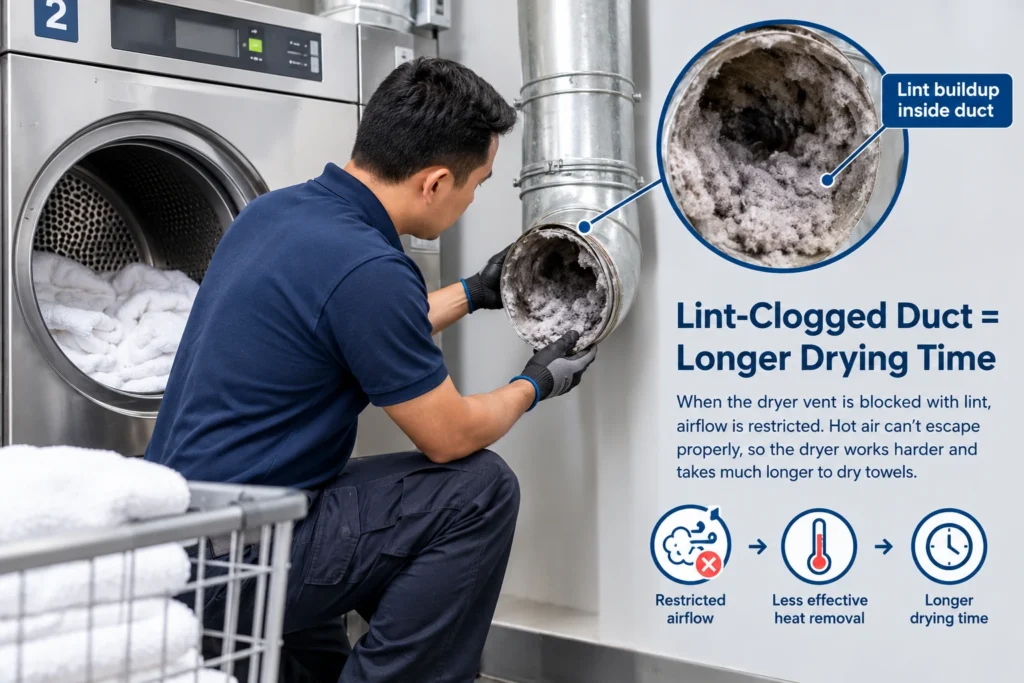
2. Is a blocked exhaust duct the real problem?
Often, yes. A dryer has to push damp air outdoors, and a crushed, overlong or lint-packed duct sends it back into the drum.
Look at where the duct leaves the building. The flap or louvre should open fully while the dryer runs. Shared ducts, many bends and long runs through ceilings are common trouble spots in shop lots and hotel back-of-house areas.
See the fix in action in our official video: official Laundry Sifu video on why a dryer takes too long.
A blocked duct is also a fire-safety concern, because lint is flammable. For the fire-safety requirements that apply to your premises, check with Bomba Malaysia.
3. Is the drum overloaded?
An overfilled drum is a common reason a dryer takes too long. Clothes packed tightly block the air that carries moisture away.
Commercial dryers are rated in kg of dry laundry, so staff should weigh a few typical loads once and mark what a correct load looks like. Bulky items such as duvets and curtains need extra room to tumble. Splitting one large load into two is often faster than one slow cycle plus a re-run.
4. Is the washer leaving clothes too wet?
If clothes arrive soaked, the dryer takes too long no matter how healthy it is. Weak spin extraction hands the dryer extra water to evaporate.
Wring a towel by hand straight after the spin. If water still runs out, check the washer’s spin speed setting, drain and load balance before you blame the dryer. Heavy cotton towels and bedding show the problem first.
5. Are dirty moisture sensors ending cycles too early?
They can be. Residue on the sensor bars makes the control misjudge dryness, so the cycle stops while clothes are still damp.
Staff then restart the cycle, and the dryer takes too long in practice even though each run looks short. Clean the bars with a soft cloth and the cleaner your manual recommends. Timer-only coin dryers may have no sensors, so check your model first.
6. Has the heating element or gas burner weakened?
If airflow is clear but the air at the vent is barely warm, the heat source is the suspect. Weak heat means the dryer takes too long and your bill climbs.
On gas models, check the LPG cylinder level and regulator first, then leave igniter and flame sensor checks to a technician. On electric models, a worn element or a supply fault, such as a lost phase on a three-phase supply, can cut heating. Ask a licensed electrician to test the voltage, and never open live panels yourself.
7. Is poor make-up air trapping humid air in the room?
Yes, and owners often miss it. A dryer draws air from the room, so a sealed laundry with no fresh-air inlet starves it and recirculates warm, damp air.
This is common in air-conditioned shop lots where the doors stay shut. Check your installation guide for the make-up air opening the manufacturer requires, and keep it unblocked.
How can I tell which cause is making my dryer slow?
Match what you see to the table below. Use it to work out why your dryer takes too long before you spend money on parts.
| What you see | Likely cause | First action | Who handles it |
|---|---|---|---|
| Heavy lint on the screen, damp clothes | Lint filter | Clean and wash the screen | Your staff |
| Hot, steamy laundry room, duct flap barely moves | Blocked duct or no make-up air | Inspect the duct and the fresh-air opening | Technician |
| Slow only when the drum is full | Overloading | Weigh loads against the rated kg | Your staff |
| Towels drip after the washer spin | Washer extraction | Check spin setting, drain and balance | Staff, then technician |
| Cycle ends early, clothes damp | Dirty moisture sensors | Clean the sensor bars | Your staff |
| Air at the vent is barely warm | Heating element, gas burner or supply | Check the LPG level and power supply | Technician or licensed electrician |
Is it normal when a dryer takes too long in the rainy season?
A small increase on humid days can be normal, but a big jump points to an airflow or heat fault, not the weather. Malaysia’s climate is humid all year, so your dryer is always working with damp intake air.
Wet months expose weak points such as a partly blocked duct, missing make-up air and a tired heater. Slow cycles also make the burner or element run longer, which shows up on your TNB or gas bill.
Across the Klang Valley, Johor Bahru, Penang and other business areas, parts for imported commercial dryers can take time to arrive. Spotting a fault early gives you time to book a repair before your busiest week.
What does it cost when a dryer takes too long?
More than most owners expect, because you lose time, energy and capacity at the same moment. Here is an illustration with round, made-up numbers. It is not Laundry Sifu data.
Say a self-service dryer earns RM6 per cycle and normally completes 12 cycles a day. If slow drying cuts that to 9, you lose 3 cycles, or RM18 a day. Over 30 days that is RM540 in lost sales, before counting extra electricity or gas and unhappy customers.
The same logic applies to hotels and hospitals, where slow dryers delay linen turnaround and force staff to work overtime.
Does the machine brand change why a dryer takes too long?
The causes are the same across brands, but filter position, sensor type and service access differ. Keep the model and serial number from the data plate ready before you ask for help.
- Electrolux: our Electrolux laundry machine service page covers support, and Electrolux Professional hosts manufacturer documentation.
- Speed Queen: see our Speed Queen laundry machine service page, and the manufacturer’s Speed Queen site for manuals.
- Huebsch: our Huebsch laundry machine service page applies. Huebsch and Speed Queen are both Alliance Laundry Systems brands.
Whatever the brand, read the installation guide for duct length and make-up air limits.
When should I call a technician if a dryer takes too long?
Call one if the three basic checks do not fix the problem within a day, or if you notice any safety sign below. Do not keep running the machine and hope it clears itself.
- A burning smell or scorched lint.
- A gas smell: switch off the supply, ventilate the room and avoid switches and flames.
- Breakers tripping, or an error code that returns after a reset.
- Cycle times that keep growing even after cleaning.
Gas work should be done by a competent, registered person, so confirm current requirements with Suruhanjaya Tenaga. Cleaning the screen and sensors is staff work. Ducts, burners and elements are technician work.
How can I stop a dryer taking too long again?
A simple routine prevents most repeat problems. Most cases where a dryer takes too long build up slowly, so catching them early is cheaper than an emergency call-out.
- Every load: empty and check the lint filter.
- Weekly: wipe the sensor bars and watch the duct flap open.
- Monthly: inspect the duct run and the make-up air opening.
- Every few months: book a technician service, and confirm the interval against your model’s manual.
Our Learning Centre adds new videos on commercial laundry machine problems, so staff can learn each check by watching it.
Dryer Takes Too Long: Your Questions Answered
Why does my dryer feel hot but still leave clothes damp?
Heat without airflow does not dry clothes. When the dryer takes too long even though the drum is hot, the filter, duct or make-up air is usually trapping the moisture.
How long should a commercial dryer cycle take?
It depends on the model, programme, load weight and incoming moisture. Use your manual and your own clean-machine baseline instead of a generic number.
Can a dirty lint filter make a dryer take too long?
Yes. A blocked filter restricts airflow, so moisture leaves slowly. Cleaning it is the quickest and cheapest test.
How often should the exhaust duct be cleaned?
Follow the manufacturer’s guidance for your model. Busy laundromats and hotels should inspect more often than quiet sites, and any lint build-up or longer cycles means clean it now.
Does Laundry Sifu service Electrolux, Speed Queen and Huebsch dryers?
Yes. Laundry Sifu services commercial laundry machines in Malaysia, including all three brands. Send your model number when you enquire.
What is the next step if your dryer takes too long?
Run the three checks today and record your cycle times. If the dryer takes too long after that, send us the brand, model and symptoms through the WhatsApp or enquiry option on our commercial laundry services page.