Quick Answer: Hard water is water carrying high levels of dissolved calcium and magnesium, and it leaves scale inside commercial washers, weakens detergent and strains heating parts. The USGS rates anything above 180 mg/L as very hard, while the Ministry of Health Malaysia lists a drinking-water hardness limit of 500 mg/L. Test your supply first, then treat it.
Hard water rarely shows up on a laundry shop’s balance sheet, yet it quietly raises repair bills, detergent use and downtime. If you run a kedai dobi, a hotel laundry or a factory wash line, this guide shows you how to spot hard water, test it and decide what to do about it.
What Is Hard Water and What Causes It?
Hard water is water that has picked up a lot of dissolved minerals, mainly calcium and magnesium. Rain turns slightly acidic as it absorbs carbon dioxide, then dissolves these minerals as it moves through rock such as limestone.
The minerals are harmless to drink, but they behave badly once the water is heated, mixed with detergent or left to evaporate. That is why laundry equipment feels the effect long before anyone notices a taste difference.
What is the difference between temporary and permanent hardness?
Temporary hardness comes from calcium and magnesium bicarbonates, and heating the water makes it drop out as scale. Permanent hardness comes from sulphates and chlorides, which stay dissolved when heated and need treatment such as softening.
For a laundry owner, the practical point is simple. Any machine that heats water will build scale from temporary hardness, and permanent hardness will still reduce how well your detergent works.
How is hard water measured?
Hardness is reported in milligrams per litre (mg/L) as calcium carbonate. The USGS uses the bands below, and they are the easiest way to read a test result.
| Hardness class | mg/L as calcium carbonate | What it means for a laundry shop |
|---|---|---|
| Soft | 0 to 60 | Little scale; normal detergent dosing usually works |
| Moderately hard | 61 to 120 | Slow scale on heating parts; monitor and descale |
| Hard | 121 to 180 | Visible scale and higher detergent use; treatment worth considering |
| Very hard | More than 180 | Fast scale and frequent faults; softening strongly advised |
Source: USGS hardness classification. The USGS notes that harder water needs more soap and detergent and contributes to scaling in equipment.
Is Hard Water a Problem in Malaysia?
It depends on where your water comes from. Most urban Malaysian supply is treated surface water, but shops on tubewells, boreholes or limestone areas can see much harder water.
A study in Sains Malaysiana tested 58 private tubewells on the West Coast of Peninsular Malaysia and found hardness from 13 mg/L to 353 mg/L, averaging about 80 mg/L. You can read the abstract on the UKM Sains Malaysiana page. That spread means two shops in the same state can face very different water.
Limestone regions are a known concern. A Universiti Teknologi MARA study of Perlis groundwater found hardness, iron, chloride and other readings high at certain locations, across four geological formations including two limestone ones.
What does the Malaysian drinking-water standard say about hardness?
The Ministry of Health’s national drinking-water standard lists hardness at 500 mg/L (as CaCO3). You can view the table in the Ministry of Health drinking water quality standard.
Note that this limit is about drinking water, not machine protection. Water can sit well under 500 mg/L and still scale a heating element, because the USGS “very hard” band starts at only 180 mg/L.
Which areas should check their water first?
Check first if you use a tubewell or borehole, operate near limestone ground (Perlis is a documented example), or have already seen white crust on taps. For Klang Valley, Johor Bahru and Penang shops on mains supply, a simple test still costs little and removes the guesswork.
How Does Hard Water Damage Commercial Laundry Machines?
It damages commercial washers in three main ways: scale on heated and sensing parts, blocked water paths, and wasted detergent. Each one turns into repair visits or lost wash cycles.
Why does scale build up on heating elements and sensors?
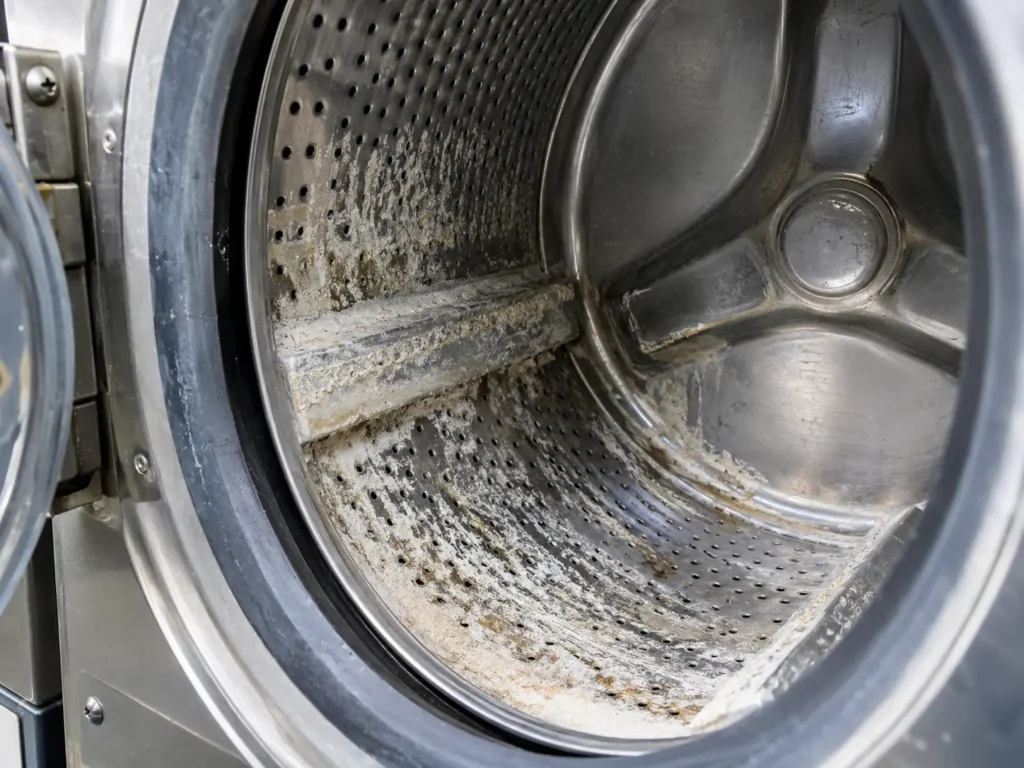
When water is heated, dissolved minerals harden into a crust. The USGS states that hard water forms scale in boilers, water heaters and pipes, and a washer with an internal heater is the same problem in a smaller space.
A scaled element has to work harder to heat the same water, which can raise your TNB bill and shorten the part’s life. Scale can also coat water-level and temperature sensors, so the machine reads the drum wrongly.
How does hard water block valves and dispensers?
Scale and loosened mineral flakes collect in inlet filters, solenoid valves and dosing lines. The result is slow filling, wrong water levels, error codes and detergent that does not reach the drum properly.
Use the quick reference below to link what you see in the shop to what is likely happening inside the machine.
| What you notice | Likely mineral link | Business impact |
|---|---|---|
| White crust on door seal or drum | Mineral deposits drying after each wash | Odour complaints, worn seals |
| Slow filling or fill errors | Scale in the inlet filter or valve | Longer cycles, fewer loads per day |
| Water not heating properly | Scaled heating element or sensor | Poor cleaning, higher electricity use |
| Stiff, greyish laundry | Minerals reacting with detergent | Customer complaints, rewashes |
| Detergent use creeping up | Extra product needed to soften the water | Higher running cost per kilogram |
See the fix in action in our official video: how to handle hard water in a commercial washer.
Why do clothes feel stiff after washing in hard water?
Calcium and magnesium react with detergent and leave a film on fabric instead of letting the detergent rinse away cleanly. Towels feel rough, whites turn dull and customers notice quickly.
For hotels and hospitals, harsh linen is not just a comfort issue. It also hurts your quality reputation, which is hard to rebuild once a client has complained.
What Are the Signs of Hard Water in a Laundry Shop?
The clearest signs are white scale, stiff laundry, slow filling and rising detergent use. Seeing two or more together is a good reason to test your supply.
- White, chalky crust on the door seal, dispenser drawer, taps or hoses.
- Detergent that lathers poorly, even at the recommended dose.
- Linen that feels rough, looks dull or develops grey patches.
- Fill errors, long fill times or low-water warnings.
- Heating faults or water that never reaches the set temperature.
- Kettles, boilers or water heaters on site that scale quickly.
- Staff reporting rough towels or customers asking for rewashes.
Keep in mind that humid Malaysian conditions can also cause odour and mildew in washers, so not every white deposit or smell comes from minerals. A test gives you the answer.
How Do You Test for Hard Water Before It Costs You?
You can measure your water hardness in under ten minutes with a hardness test kit or strips, or by asking your water operator for its supply data. Test kits are sold at hardware and pool shops, and results come in mg/L or grains per gallon.
- Take a clean cup of water from the tap that feeds your machines, not from a different part of the building.
- Use a hardness test strip or titration kit and follow its instructions.
- Convert the result to mg/L as calcium carbonate if the kit uses grains per gallon (1 grain per gallon is about 17.1 mg/L).
- Compare the result with the USGS table above.
- Repeat after heavy rain and in dry spells, because source water can change through the season.
- For a formal result, ask a lab or your state water operator, such as Air Selangor, SAJ in Johor or PBAPP in Penang, for their supply data.
Write the result and the date in your maintenance log. Having a number in hand also makes any later conversation with a technician much faster.
How Can You Fix Hard Water in a Laundromat?
You fix the problem by treating the water, maintaining the machine, or both. Softening protects the machine at the source, while descaling and dosing changes manage the effects.
| Option | What it does | Best for | Watch out for |
|---|---|---|---|
| Ion-exchange water softener | Swaps calcium and magnesium for sodium or potassium | Hard to very hard water, multiple machines | Needs space, salt and regular servicing |
| Scheduled descaling | Removes scale from machine parts | Moderately hard water, any shop | Use only products the manufacturer allows |
| Inlet filter cleaning | Clears debris and flakes from fine screens | Every shop, every brand | Easy to forget without a checklist |
| Detergent dosing review | Matches product and dose to your water | Shops with stiff laundry or high detergent use | Overdosing makes residue worse |
Do you need a water softener for a kedai dobi?
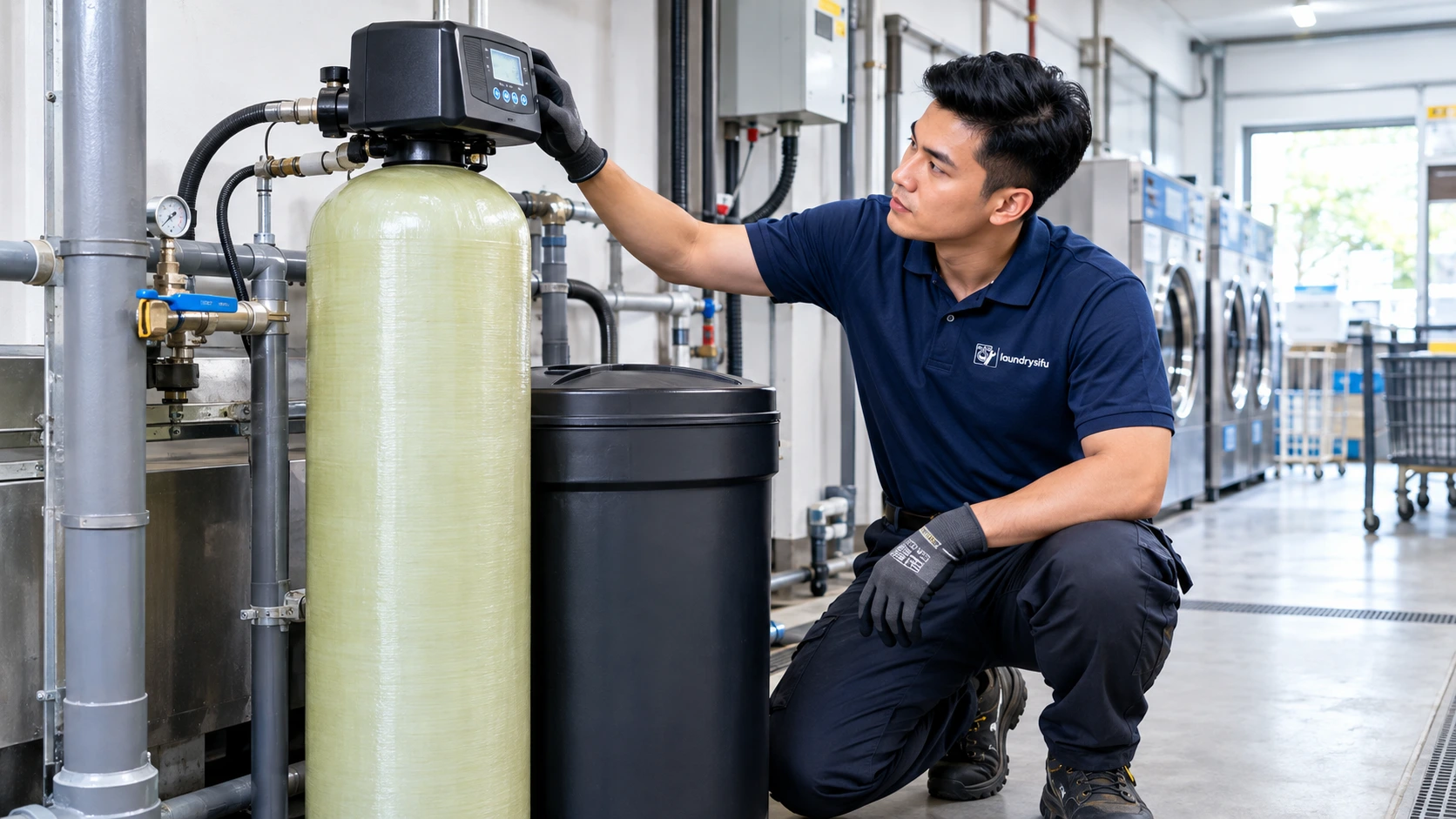
If your test shows hard or very hard water, a softener is usually the most effective protection because it stops scale before it reaches the machines. If your result is soft to moderately hard, regular maintenance may be enough.
Size the unit to your daily water use and peak flow, and ask the supplier how often it needs regeneration and servicing. A system that is too small will let hardness through at busy times.
How often should you descale commercial washers?
Match the descaling interval to your test result and the manufacturer’s manual, and shorten it if you see faults or crust. Harder water means a shorter interval.
Use only descaling products the manual approves, because the wrong acid can damage seals and stainless steel. When in doubt, ask a technician before you pour anything into the drum.
Can you just add more detergent?
More detergent can mask the problem for a while, but it raises your cost per kilogram and can leave residue in fabric and machines. Treating the water costs less over time than dosing around it.
Does Hard Water Affect Electrolux, Speed Queen and Huebsch Machines?
Yes, any commercial washer can be affected, because scale depends on your water and not the brand. What differs between machines is how much heated, fine-tolerance or sensing hardware the water touches.
Always follow the water-quality guidance in your own manual, and ask your supplier for the manufacturer’s recommended limits. Laundry Sifu supports these brands across Malaysia:
- Owners of front-loaders can see our Electrolux laundry machine service page.
- Shops running top-loaders and coin-op lines can view our Speed Queen laundry machine service page.
- Huebsch owners can read about our Huebsch laundry machine service in Malaysia.
If you want to see typical faults before calling anyone, our Learning Centre adds new videos on commercial laundry machine problems.
How Much Can Hard Water Cost a Laundry Business?
It costs money through repairs, downtime, extra detergent and higher energy use. The biggest hit is usually downtime, because an idle machine earns nothing.
Here is a simple illustration, not a Laundry Sifu statistic. If a washer earns RM8 per cycle and runs 10 cycles a day, it makes RM80 a day. Three days waiting for a part costs RM240 in lost sales, before repair costs.
Spare-part lead times, staff shortage and a rainy-season rush can stretch that wait. Preventing scale is usually cheaper than waiting for a part to arrive.
Frequently Asked Questions About Hard Water
Is hard water safe to drink?
Yes, hard water is generally safe to drink, and the minerals involved are not toxic. The problem is mainly equipment scale and poor detergent performance, which is why laundries feel it first.
Can boiling remove hard water?
Boiling removes only temporary hardness, because the bicarbonates drop out as scale. It does nothing for permanent hardness, and it is not practical for a commercial washer’s water supply.
Does hard water make clothes stiff?
Yes. Minerals react with detergent and leave residue on fibres, so laundry can feel rough and look dull. Softening the water or adjusting dosing usually improves the feel.
Will hard water void my machine warranty?
Check your warranty terms. Some manufacturers set water-quality conditions, and damage linked to scale may not be covered. Ask your supplier for the written conditions before a fault happens.
How do I know if I have hard water without a lab test?
Look for white crust, poor lather, stiff linen and fill errors, then confirm with a test strip. Strips give a fast estimate, and a lab or water operator can give a formal figure.
Next Step: Get Your Hard Water Problem Checked
Test your water this week and write down the result. If it shows hard or very hard water, or your machines already show scale, speak to a technician before a small fault becomes a long shutdown.