Quick Answer: Boiler pressure issues mean your steam or hot-water pressure has drifted outside the safe working range printed on the boiler nameplate, running too low to heat properly or too high for the safety valve. This guide covers eight common causes, from leaks to failed expansion vessels. Laundry Sifu has serviced commercial laundry equipment in Malaysia since 2014.
Boiler pressure issues can switch off a laundry’s income faster than almost any other fault. When the gauge falls too low, machines heat slowly and cycles drag on. When it climbs too high, the safety valve may start venting.
This guide explains the causes, the safe checks your team can do and the point where you must call a technician. It is written for kedai dobi, hotel, hospital and factory laundry owners across Malaysia.
What Is Normal Pressure for a Commercial Laundry Boiler?
Normal pressure is the working range printed on your boiler’s nameplate and in its manual. It is not one number that suits every plant, because steam boilers, hot-water boilers and small home heating units all run at different pressures.
Many online guides quote figures for wall-hung home heating boilers. Those numbers do not apply to a commercial laundry, and using them to judge your own gauge can send you down the wrong repair path.
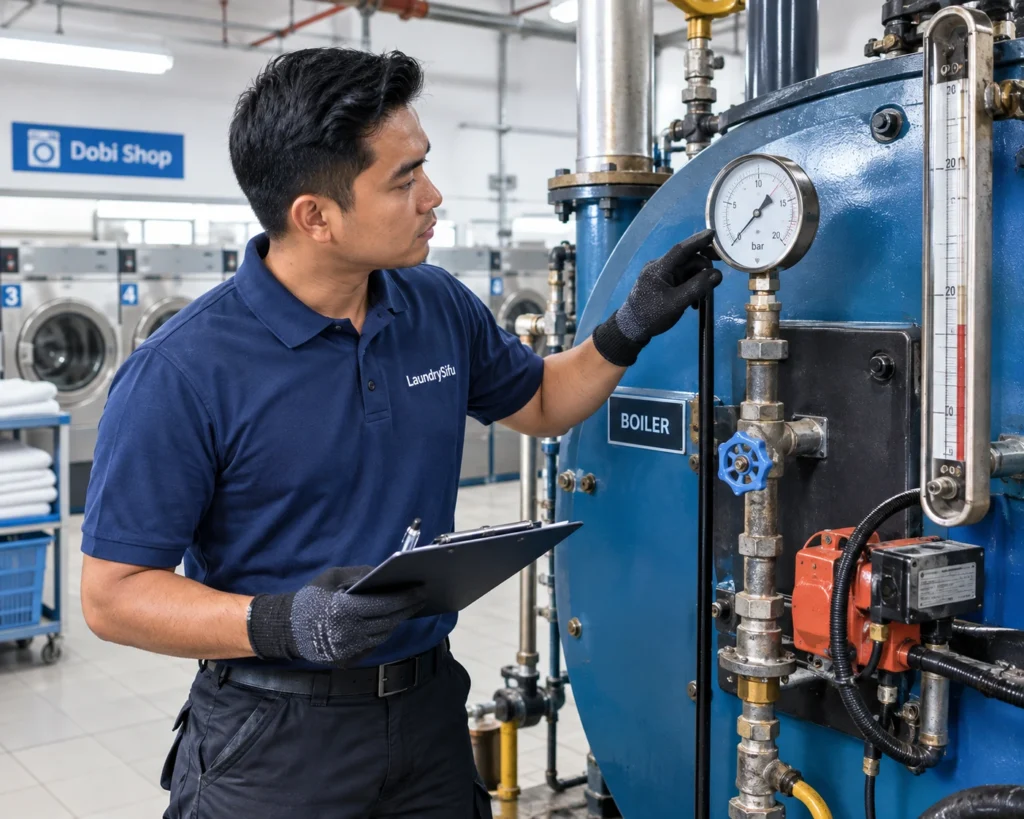
Ask your technician to confirm three values and mark them beside the gauge. They are the normal operating pressure, the lowest pressure at which your machines still heat properly, and the set pressure of the safety valve.
Readings also change with temperature, because water expands as it heats. A small rise while the boiler warms up is normal. A large jump, or a steady fall overnight, is a sign of boiler pressure issues that deserve attention.
What Causes Boiler Pressure Issues in a Commercial Laundry?
Boiler pressure issues usually come from a short list of faults. The table compares eight of them, including what you will see and who should fix each one.
Some rows apply only to closed hot-water circuits that use an expansion vessel. Steam boilers behave differently, so confirm your boiler type with your technician.
| Cause | Pressure effect | Typical sign | Who should fix it |
|---|---|---|---|
| 1. Slow leak at joints, unions or valves | Low | Damp patches, mineral crust, frequent top-ups | Technician |
| 2. Recent draining or blowdown | Low | Gauge sits low after flushing or maintenance | Trained operator, following the manual |
| 3. Weeping safety valve | Low | Water or steam at the discharge pipe | Technician |
| 4. Failed expansion vessel (ruptured diaphragm) | Low, then swings | Pressure moves sharply between cold and hot | Technician |
| 5. Overfilled system | High | High reading from cold, valve drips | Trained operator or technician |
| 6. Lost air charge in expansion vessel | High | Rapid spikes on every heating cycle | Technician |
| 7. Safety valve not reseating | High or low | Repeated discharge after the valve lifts | Technician |
| 8. Faulty gauge or pressure control | False or real | Gauge sticks or disagrees with the controller | Technician |
Fixing boiler pressure issues starts with knowing whether the gauge is falling or climbing. The two directions have different causes.
What Causes Low Boiler Pressure?
Low pressure means water or steam is leaving the system, or was removed on purpose and not replaced.
Slow leaks come first. A weeping union, valve gland or pipe joint can lose a little water every day, and staff often miss it because only the gauge shows the loss.
Recent draining or blowdown is the second cause. Flushing, descaling and maintenance all remove water, so the gauge will sit low if the system is not refilled and checked afterwards.
A weeping safety valve is the third. A worn or dirty valve seat lets water or steam escape through the discharge pipe, and you should never tighten or adjust it yourself.
A failed expansion vessel is the fourth. When its diaphragm ruptures, it can no longer absorb expansion, so pressure may first look low and then spike when the boiler heats.
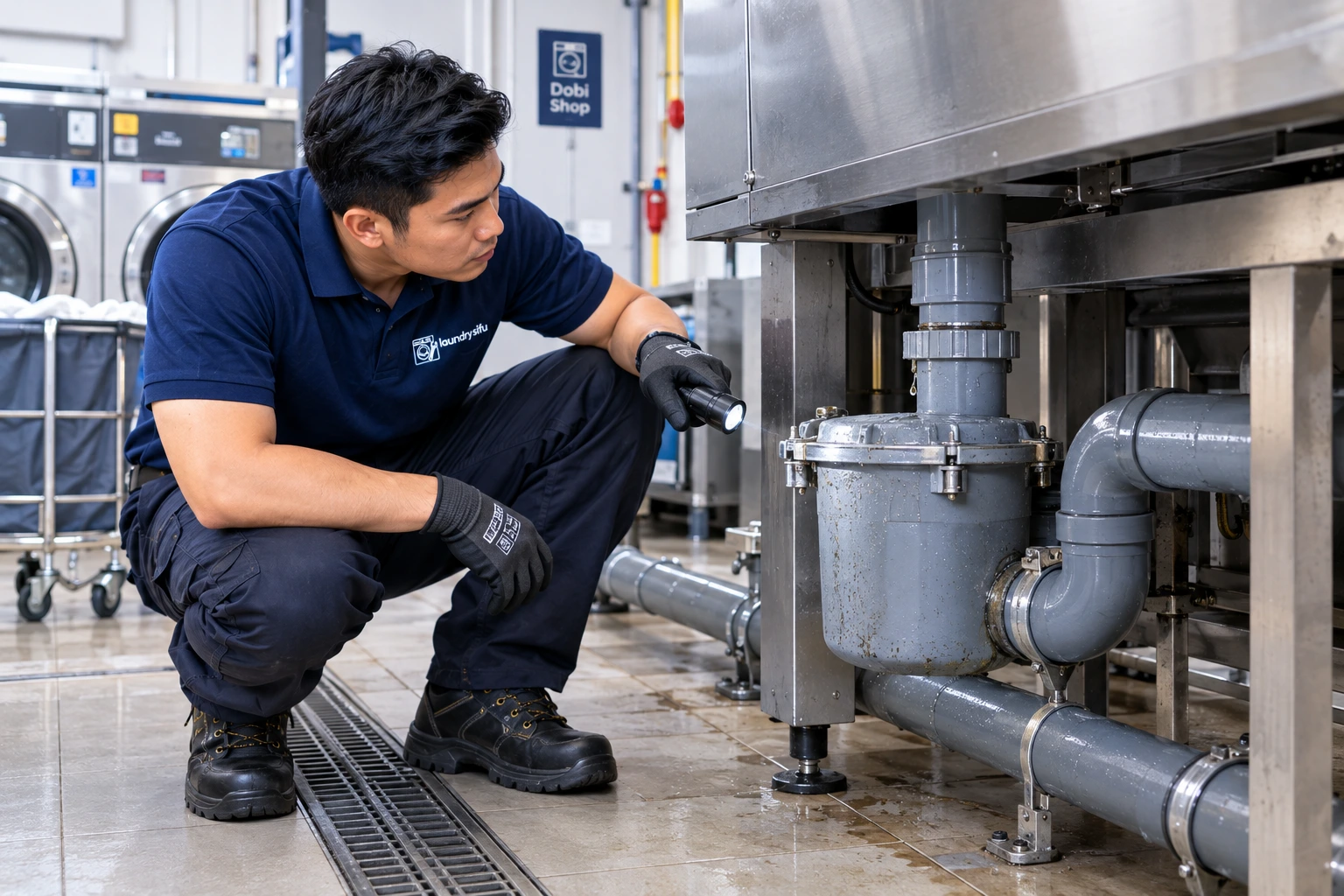
In our service visits, boiler pressure issues often trace to a leak nowhere near the boiler. We regularly find it at a joint behind a machine or in a floor trench, so walk the full pipe run and not just the boiler room.
What Causes High Boiler Pressure?
High pressure means too much water was added, the system cannot absorb expansion, or the safety devices are not working.
Overfilling happens when a make-up water valve is left open or sticks open. The gauge then reads high even when the boiler is cold.
A lost air charge in the expansion vessel has the same effect during heating. Pressure spikes quickly because the vessel has no cushion left to absorb the expanding water.
A safety valve that does not reseat keeps discharging after it lifts. A faulty gauge or pressure control can also mislead you, so have the gauge tested before trusting any reading.
High pressure is a safety risk. If the safety valve is discharging, treat the boiler pressure issues as urgent, keep people clear and call a technician at once.
How Do You Check for Boiler Pressure Issues Safely?
If you suspect boiler pressure issues, read the gauge, look for leaks from a safe distance and compare the reading with your log. Do not open valves on a hot, pressurised boiler.
- Read the gauge at the same point in every shift and write the value in a log.
- Compare it with the working range on the nameplate and in the manual.
- Look around joints, valves and the discharge pipe for water, steam or rust marks, without opening any panel.
- Note machine symptoms such as slow heating, longer cycles or lockouts.
- If the reading is outside the range, or keeps falling, follow the shutdown procedure in the manual and call a technician.
Home heating guides often tell owners to open a filling loop or bleed radiators. Commercial plants use different make-up water arrangements and pressurised steam, so those steps can be wrong or unsafe in a laundry.
See the fix in action in our official video: boiler pressure issues video from Laundry Sifu.
Which Boiler Pressure Issues Can Your Staff Handle?
Your staff can spot boiler pressure issues early by monitoring, logging and reporting readings. Repairs to safety valves, pressure parts and controls belong to a competent, qualified person.
Staff can safely:
- Read and log the gauge every shift.
- Check for visible leaks from a safe distance.
- Report any discharge from the safety valve.
- Follow the shutdown steps written in the manual.
Call a technician for:
- Any safety valve discharge.
- Repeated pressure loss or frequent top-ups.
- Pressure swings between cold and hot.
- A gauge that sticks or disagrees with the controller.
- Any repair to pressure parts.
In Malaysia, boilers are regulated under the Factories and Machinery Act 1967 and enforced by JKKP, also known as the Department of Occupational Safety and Health (DOSH). Steam boilers generally need inspection and a valid certificate of fitness before they operate. Confirm the exact requirements for your boiler type with DOSH.
When you replace a safety valve or gauge, ask the supplier for its certification papers. SIRIM, Malaysia’s national standards and quality organisation, is a useful starting point for standards questions.
How Do Boiler Pressure Issues Affect Your Laundry Machines?
Boiler pressure issues hit machines that rely on steam or a central hot-water supply first. They heat slowly when pressure falls, and may stop or show faults when it swings.
Machines with their own electric or gas heating do not depend on the boiler, so confirm the heat source first.
As an authorised Electrolux partner, Laundry Sifu checks the supply side as well as the machine when an Electrolux plant heats slowly. Our Electrolux laundry machine service covers that diagnosis for laundromats and commercial laundries.
Where your Speed Queen washers or dryers draw on boiler-supplied heat, a pressure fault looks like a long cycle or weak drying. Our Speed Queen laundry machine service separates machine faults from supply faults, so you do not replace good parts.
The same logic applies to Huebsch equipment. Our Huebsch laundry machine service team checks inlet valves, filters and heat supply before pointing to the boiler.
Rule out machine-side causes first, because a blocked inlet screen or a sticking valve can mimic boiler pressure issues.
How Does Malaysia’s Climate Affect Boiler Pressure Issues?
Heat, humidity and variable water quality add wear that shows up as pressure faults. The effect is gradual, so it is easy to miss until a machine stops.
Tropical humidity speeds up corrosion on fittings, gauges and wiring in boiler rooms. Corroded joints are a common start to boiler pressure issues.
Water quality also matters. Scale build-up depends on your local supply, so ask for a water test and a descaling plan rather than guessing.
Power quality matters too. During rainy-season storms, supply dips or trips can stop feed pumps and controls, so follow the restart steps in your manual and check the gauge afterwards.
Spare parts can slow recovery. Whether you operate in the Klang Valley, Johor Bahru or Penang, imported gauges and safety valves may take time to arrive, so keep key spares on site.
Every day of downtime costs wash revenue while staff wages and utility bills carry on.
How Can You Prevent Boiler Pressure Issues?
Preventing boiler pressure issues is mostly routine: read the gauge every shift, inspect weekly and book professional servicing on schedule.
- Every shift: read and log the gauge, and look for drips, steam or wet patches.
- Weekly: check the safety valve discharge pipe for staining or moisture, and listen for unusual noise.
- Monthly: inspect fittings for rust or mineral crust, and confirm the gauge needle moves freely.
- Annually, or as your certificate requires: full inspection by a competent person, including the safety valve, expansion vessel and controls.
Keep the log in writing. A two-week trend tells a technician far more than a single reading taken on the day of breakdown.
Our Learning Centre posts new videos on commercial laundry machine problems, so your team can learn the warning signs.
Boiler Pressure Issues FAQ
What is a normal boiler pressure for a laundry?
It is the range on your boiler nameplate and in the manual, which differs by boiler type and manufacturer. Figures for home heating boilers do not apply. Ask your technician to mark the safe range on the gauge.
Why do boiler pressure issues keep coming back?
Boiler pressure issues return when the root cause is still there, such as a hidden leak, a failed expansion vessel or a worn safety valve. Topping up only hides the fault for a while. A technician should find and fix the source.
Is high boiler pressure dangerous?
Yes, it can be. The safety valve exists to protect the boiler, so any discharge is a warning to act. Never block, tighten or adjust the valve, and call a qualified technician immediately.
Can I top up boiler pressure myself?
Only a trained operator should do it, and only if the manual allows it. Never add water to a hot, pressurised boiler. If you need to top up often, you have a leak or another fault.
How often should a boiler be inspected in Malaysia?
Steam boilers usually need periodic statutory inspection by a competent person under JKKP rules, commonly yearly. Confirm the exact interval with DOSH. Routine servicing should be more frequent than the statutory inspection.
What Is the Next Step if You Have Boiler Pressure Issues?
Log your gauge reading every shift for three days and note any drips, noise or slow heating. That record helps a technician find the cause faster.
Then send your boiler details and readings through a contact or WhatsApp inquiry on our commercial laundry services page. Laundry Sifu provides servicing and preventive maintenance, and customers on a maintenance contract also receive our free 10-point health check.
Acting early on boiler pressure issues usually costs far less in RM than a day of lost wash cycles.