Quick Answer
A commercial washer won’t spin most often because of an unbalanced load, water still sitting in the drum, a door lock that isn’t registering, a worn drive belt, or a failed motor, inverter drive or control board. The controller deliberately blocks the spin until the door is locked, the drum has drained and the load is balanced. Check those three things first, because they fix most faults without a service call.
If your commercial washer won’t spin but still fills and washes, the machine is rarely “dead”. More often, a safety check has failed and the controller is refusing to go to high-speed extract. This guide covers the seven causes in the order a technician would check them, what you can safely do yourself, and when to stop and call for service.
Commercial Washer Won’t Spin and Won’t Drain? It’s Often the Same Problem
Operators usually report “won’t spin” and “won’t drain” as two separate faults. In practice they are often one. Almost every commercial washer-extractor waits for the water level to drop before it allows high-speed extract. So a commercial washer won’t spin whenever the drain step hasn’t finished, and a machine that won’t drain will never reach spin.
That is why drain is the second thing to check, not the last. If there is standing water in the drum, fix that first and the spin problem often resolves itself.
Why a Commercial Washer Won’t Spin: What the Controller Checks
Before it allows high-speed spin, the controller confirms four things:
- The door is locked. The lock circuit must report closed.
- The drum has drained. The water level must fall below a set point.
- The load is balanced. Vibration or an out-of-balance switch must be satisfied.
- The motor is getting correct power. The drive and supply must be healthy.
If any check fails, the machine pauses, retries, finishes at low speed, or stops with an error code. Here is how the seven causes of a commercial washer won’t spin map to those checks:
| Likely cause | Typical symptom | Can you fix it yourself? |
|---|---|---|
| Unbalanced or overloaded drum | Thumps, pauses, retries the spin, linen comes out wet | Yes |
| Door lock or lid switch fault | Door or lock error, drum never turns | Partly (cleaning and re-closing only) |
| Blocked drain, drain valve or pump | Water left in the drum | Partly (accessible filters and hoses only) |
| Worn or snapped drive belt | Motor hums or runs, drum barely moves | No |
| Failed motor or capacitor | Humming, burning smell, tripped breaker | No |
| Faulty inverter drive or control board | Error codes, random stops mid-cycle | No (one power reset only) |
| Worn bearings, shock absorbers or springs | Grinding, violent shaking, spin cutouts | No |
7 Causes Why a Commercial Washer Won’t Spin
Work through these in the order a technician would check them. The first three are the quickest and cheapest to rule out.
1. Is an Unbalanced Load Stopping the Spin?
Yes, and it is the most common and cheapest reason a commercial washer won’t spin. Washer-extractors spin fast, so they check the load for balance first. A lopsided load makes the machine abort the spin, redistribute and retry a few times, then either finish at low speed or stop with a fault.
What it looks like: the machine washes and drains normally, tries to speed up, shudders, drops back down and repeats. You end up with heavy, wet linen or a balance error.
Bedsheets wrapped around one heavy item, a single soaked duvet, balled-up towels and mop heads are the usual triggers. Overloading makes it worse, and running a very small load can cause it too.
What to do:
- Pause the cycle and open the door only once the drum has fully stopped.
- Untangle sheets and spread heavy items evenly around the drum.
- Remove items if the drum is packed, or add items if the load is very small.
- Restart the spin or run a short extract cycle.
When it’s a repair: if balance faults keep returning with well-distributed, normal loads, something mechanical has changed. On softmount machines that usually means worn shock absorbers or springs, or a faulty vibration sensor. On hardmount machines, a sticking out-of-balance switch or loose anchor bolts can be the cause. If a hardmount machine is visibly moving on its base, stop using it and get it inspected, because that is a safety issue.
2. Could a Faulty Door Lock or Lid Switch Be the Problem?
Yes. If the machine doesn’t detect a locked door, it won’t spin. The door interlock is the main safety system on a washer-extractor, and the controller is strict about it. If the lock signal drops mid-cycle, the drive is cut, which the operator sees as “it just won’t spin”.
What it looks like: the cycle won’t start, stops early, or the drum never turns even though the machine fills. Some machines show a door or lock error, others simply wait.
Quick checks:
- Close the door firmly and listen for the lock click.
- Look for lint, laundry or a damaged gasket edge caught between the door and seal.
- Inspect the door hook and strike plate for debris or bending.
- Note any “door” or “lock” error code and compare it with the manual.
- Remind staff not to slam the door, since repeated impact bends strikes and wears out lock motors early.
When it’s a repair: if the door seats properly but the fault stays, the lock motor, lock switch, relay or wiring has failed. Replacing these means working with live wiring, so leave it to a technician. Never jumper or bypass an interlock to get through the day. A drum that can spin with the door open can cause serious injury, and under Malaysia’s Occupational Safety and Health Act 1994, employers must keep machinery safe (see DOSH).
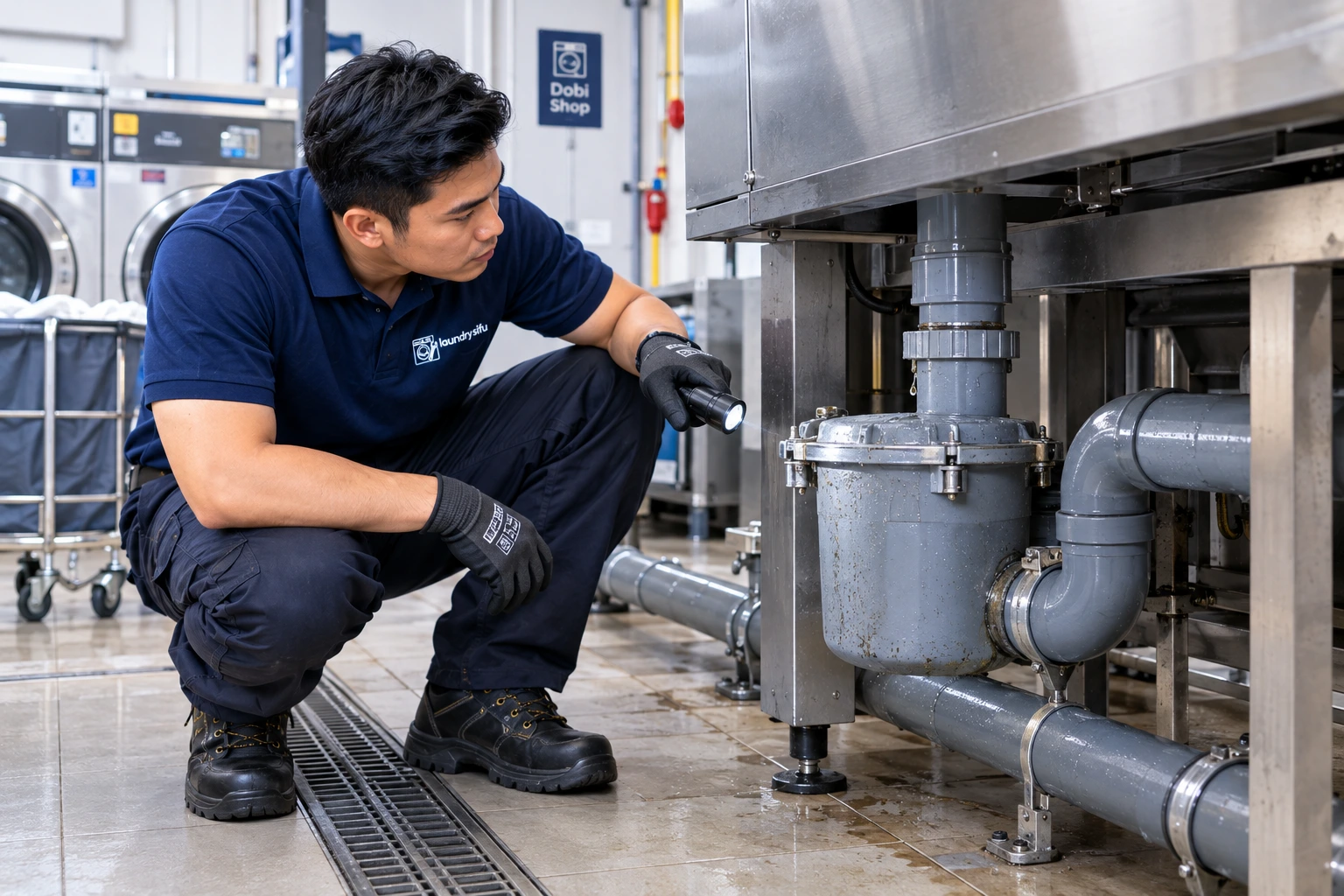
3. Is a Blocked Drain Preventing My Washer From Spinning?
Yes. Most commercial washers won’t start spinning until the water has drained below a set level. The controller holds the spin to protect the motor and the load, so a commercial washer won’t spin while water is still sitting in the drum.
Washers drain in one of two ways: through a large drain valve (usually held shut by an electric coil during the wash) or through a motorised drain pump on machines that have to lift water to the drain line.
What it looks like: standing water in the drum after the drain phase, a drain step that takes longer and longer, or a pump that hums but moves no water.
Common causes:
- Foreign objects. Coins, pens, buttons, bra wires, screws and rags collect in the drain valve body or jam the pump impeller. This is the most common thing technicians pull out of a drain system. A jammed pump may hum, trip its thermal protector, or run without moving water.
- Lint and detergent buildup. The drain path narrows slowly until the machine starts timing out on the drain step.
- A failed drain valve coil. Depending on the valve design, it can fail closed (the bath never empties and the machine won’t advance to spin) or fail open (water runs straight out and the machine can’t hold a fill).
- A failing pump motor. Seized bearings, burned windings or a cracked impeller leave water in the drum at the end of the cycle. A pump that has become noticeably louder over recent weeks is often about to stop.
- A backed-up building drain. If nearby floor drains are slow too, the washer isn’t the problem.
What you can do: isolate the power first. Then clear visible blockages, clean any accessible drain filter as your manual describes, check the drain hose for kinks, and confirm the floor drain accepts water freely. If the pump is silent or hums without moving water, it likely needs replacing. Anything past that means opening a machine that holds water and line voltage, which is technician work.
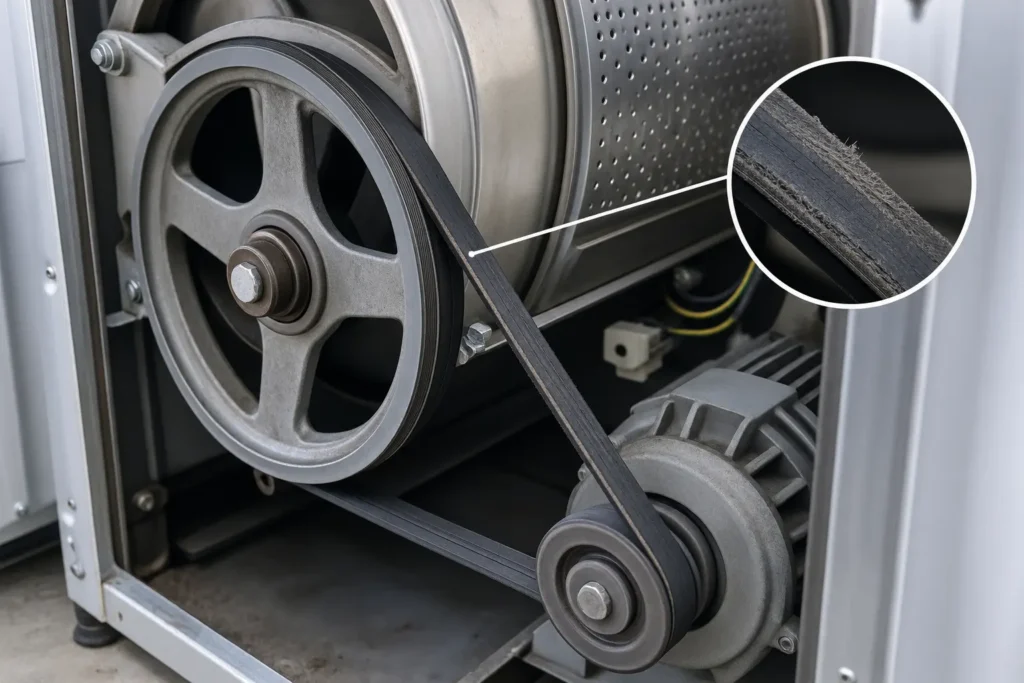
4. Does a Worn Drive Belt Make a Commercial Washer Stop Spinning?
Yes. A snapped or slipping belt means the motor runs but the drum doesn’t turn. On belt-driven washer-extractors, one or more belts carry power from the motor to the drum. Heavy daily use stretches, glazes and eventually breaks them. It is a classic reason a commercial washer won’t spin at all.
What it looks like:
- A squeal during spin and a burning-rubber smell, which means the belt is slipping.
- A motor that hums or runs while the drum stays still, which often means a snapped belt.
- A spin that starts weakly and fades.
What to check: with the machine isolated, a maintenance technician can look through the rear access panel for cracks, glazing and fraying. Rubber dust collecting in the belt guard is an early warning that the belt is wearing fast.
When it’s a repair: belts sit behind panels next to moving parts, so replacement and tensioning should be done by a technician. Just as important, a belt is often the symptom, not the cause. A belt that keeps failing usually points to pulley misalignment, a failing motor bearing or a rough-turning drum bearing. Fixing only the belt means paying for the same repair again.
Sifu Tang shows what to look for in this short video on checking the belt, door lock and heavy loads on the official Laundry Sifu YouTube channel.
5. Is the Motor or Capacitor Failing?
If a commercial washer won’t spin and you hear humming, the motor or its capacitor may have failed. A motor that cannot start will hum, overheat or trip the breaker.
Warning signs: a burning smell, a motor that hums but won’t turn, tripped breakers, or the machine stopping mid-spin.
Switch the machine off at the isolator and call a technician. Do not keep pressing start. Repeated restarts can burn out the windings and turn a capacitor replacement into a motor replacement.
6. Is the Inverter Drive or Control Board at Fault?
Yes, this is a common cause on newer machines. Modern washer-extractors use an inverter drive (a variable frequency drive, or VFD) to control drum speed, from gentle wash tumbling to high-speed extract. If the drive detects over-current, over-voltage, a ground fault, a DC bus problem or lost communication with the main controller, it shuts the motor down to protect itself. The operator sees a machine that fills and drains but never spins, or stops mid-cycle with a code.
Why it happens: overheating, power surges, moisture, or an unsuitable electrical supply. Malaysia’s standard supply is 230V single-phase and 400V three-phase at 50Hz, according to Suruhanjaya Tenaga (Energy Commission). A machine configured for the wrong supply, or suffering phase loss, can fail to spin or damage the drive.
One safe thing to try: a single full power reset. Switch off at the isolator, wait at least 60 seconds, restore power and run a short drain-and-spin cycle. A one-off surge can trip a drive without lasting damage.
Stop if the fault returns. If it comes back after one reset, a component has failed. Running through drive faults can take the motor with it. Also, capacitors inside a drive can hold a dangerous charge after the power is off, so drive diagnosis and replacement is strictly technician work.
Fault codes differ by brand. The same failure reads out differently on Electrolux, Speed Queen, Huebsch and Dexter machines, and even between control generations of the same brand. Don’t trust a generic code table from the internet. Photograph the display, write the code down exactly, and send it to your technician. It tells them which parts to bring.
7. Can Worn Bearings or Shock Absorbers Cause Spin Failure?
Yes. Worn bearings and suspension parts cause violent shaking, grinding noises and spin cutouts. These are mechanical faults, and they get worse the longer the machine runs.
Signs: a rumble that rises with drum speed, a drum that wobbles or feels rough when turned by hand with the power off, or knocking during extract.
Stop using the machine. Continued use risks damaging the drum, shaft and frame, which turns a repair into a replacement. On softmount machines, worn shock absorbers and springs also trigger the balance faults described in cause 1, so a “balance problem” that won’t go away is often a suspension problem.
What to Check First When a Commercial Washer Won’t Spin
When a commercial washer won’t spin, run this five-minute check: power, load, door, drain and error code. It fixes a large share of minor faults and gives your technician useful information if you do need to call.
- Power: Is the display on and the breaker or isolator on? A dead display is an electrical fault, not a spin fault.
- Load: Reduce the load and rebalance it. Is it near the rated capacity, and not overloaded?
- Door: Re-close it and listen for the lock click. Check nothing is caught in the gasket.
- Drain: Look for standing water and a kinked or blocked drain hose. Check whether nearby floor drains are slow.
- Error code: Photograph the display before power-cycling the machine.
Isolate the power before you open any panel.
When to Stop Using the Machine and Call a Technician
Stop and arrange service if your commercial washer won’t spin and you notice any of the following:
- Standing water that your basic checks can’t clear
- A burning smell, smoke or scorched insulation
- A drive or motor fault that returns after one power reset
- Balance faults that repeat with well-distributed loads, or a machine visibly moving on its base
- A door that closes but won’t lock, or any temptation to bypass the interlock
- Grinding, knocking or squealing during spin
What Can You Fix Yourself, and What Should You Leave to a Technician?
When a commercial washer won’t spin, do it yourself only for load balancing, clearing accessible blockages and a single power reset. Call a professional for anything involving electrical parts, belts, bearings, lock assemblies or sealed drain components. A wrong DIY repair can void warranties, extend downtime and put staff at risk, and downtime usually costs a laundromat or hotel more than the repair itself.
How to Prevent Spin Problems Before They Start
Most of the reasons a commercial washer won’t spin give weeks of warning. A short routine catches them early.
- Daily: Empty pockets before loading, since coins and hardware are a leading cause of drain damage. Wipe the door seal and check the door closes without force. Weigh or measure loads instead of guessing.
- Weekly: Clean accessible drain filters and lint traps. Listen during spin for new squeals, grinding or knocking.
- Monthly: Check the belt condition and tension (machine isolated). Check that anchor bolts on hardmount machines are tight. Watch how long the drain step takes, because a step that keeps getting longer is a blockage forming.
- Quarterly: Inspect shock absorbers and springs on softmount machines. Clear dust from drive cooling vents. Review the machine’s fault history if it keeps one, because repeating balance or drain faults are a trend, not a coincidence.
- Annually: Have a technician inspect the bearings, seals, door lock assembly and the full drain path.
Does the Machine Brand Matter When Troubleshooting?
Yes. Error codes, lock designs and drive systems differ by brand, so always match your steps to the manual. Each manufacturer has its own fault code library and controller logic.
If your commercial washer won’t spin and shows a brand-specific error code, match it to your manual before doing anything else. For manuals and error code references, see Electrolux Professional or Alliance Laundry Systems, the parent company of Speed Queen and Huebsch. Laundry Sifu’s brand pages cover:
- Electrolux laundry machine service in Malaysia
- Speed Queen laundry machine service
- Huebsch laundry machine service in Malaysia
More visual walkthroughs of common faults are in our learning centre.
FAQ
Why won’t my commercial washer spin?
A commercial washer won’t spin most often because of an unbalanced load, water still in the drum, a door lock that isn’t registering, a worn drive belt, or a failed motor, inverter drive or control board. The controller blocks the spin on purpose if the door isn’t locked, the drum hasn’t drained or the load is unbalanced. Check those three first.
Why does my commercial washer fill and wash but not spin?
That pattern usually means the washing stage works but a spin condition isn’t being met. Look for standing water, an unbalanced load, a door lock that isn’t registering, or a slipping belt. If the motor hums while the drum stays still, suspect the belt or motor.
Why won’t my commercial washer spin or drain?
Because most controls block spin until the water has drained, the two faults are often linked. A blocked drain valve, a jammed pump, a failed drain valve coil, or a backed-up building drain can cause both. Fix the drain first and the spin often returns.
How do I reset a commercial washer that won’t spin?
Switch it off at the isolator, wait at least 60 seconds, restore power and run a short drain-and-spin cycle. Reset procedures vary by model, so check your manual. If a commercial washer won’t spin again after one reset, a part has failed and resetting again won’t help.
Can an overloaded commercial washer stop spinning?
Yes. Overloading causes imbalance and strains the motor and bearings. Stay within the dry-weight capacity in the manufacturer’s manual. Very small loads can also trigger balance faults, so aim for a load near the rated capacity.
Is it safe to keep using a washer that won’t spin properly?
No, not if you hear grinding, smell burning, or see heavy shaking. Isolate it and arrange service, because continued use can turn a small repair into major damage.
Can I replace a belt or drain pump myself?
Belts sit next to moving parts, and drain components hold water and line voltage. Parts also need to match your exact make and model. For safety and to avoid repeat failures, have a technician do these repairs.
How much does it cost to fix a commercial washer that won’t spin?
What it costs depends on why your commercial washer won’t spin. A load or drain fix costs little, while belts, motors, drives and control boards cost more. A technician’s inspection is the only reliable way to quote.
Your Next Step
If your commercial washer won’t spin after the five-minute check, stop using it and note the error code. Then message Laundry Sifu on WhatsApp (+60 11-5872 4533) with the machine brand, the error code and a photo of the display, or contact us for diagnosis before a small fault becomes costly downtime.
Laundry Sifu has been established since 2014 and is a registered vendor for Simple Clean, Electrolux, Fagor, Huebsch, Speed Queen, Enegean, Blue Whale and Dexter, with technical support and original spare parts for laundromat owners across Klang Valley and Selangor. See our commercial laundry machine servicing for details.